How to Prepare a Corporate Carbon Report [Full Guide]

![สอนวิธีจัดทำรายงานคาร์บอน สำหรับองค์กร [ฉบับเต็ม]](https://blog.carbonwize.io/content/images/size/w1200/2025/11/how-to-report-an-carbon-footprint-for-organization.png)
Today, customers, investors, international partners, and regulatory bodies are increasingly asking the same question: “How much greenhouse gas does your organization emit?” A corporate carbon report is no longer just an environmental document; it has become..
- Crucial information for business competitiveness
- A key indicator of readiness for Net Zero targets
- An essential database for addressing ESG and sustainability disclosure requirements
Understand “Corporate Carbon Footprint (CFO)” before getting started
Corporate Carbon Footprint (CFO) is the total amount of greenhouse gases emitted from an organization's activities within a 12-month period or one calendar year, converting all types of gases into a single unit: tons of carbon dioxide equivalent (tCO₂e).
The key point is that a corporate carbon report is not just a “total number”.
It is a database that can be leveraged in many ways, such as:
- Setting emission reduction targets (Target / Net Zero / SBTi)
- Referencing in Sustainability Reports / One Report / ESG Reports
- Submitting to government agencies (e.g., TGO) or international partners requiring carbon footprint data
- Using in business negotiations to enhance ESG credibility with customers and investors
- Serving as a database for designing Decarbonization Plans and sustainability investments
Start Right: Understand Boundary, Scope, and Base Year Before Preparing a Carbon Report
1) Define Boundary (Organizational Boundary)
Defining Organizational Boundary means answering the question:
“Which parts of the organization’s greenhouse gas emissions will we count?” For example:
- Will we count only the head office, or also factories, branches, warehouses, subsidiaries, etc.?
- Will we use the Operational Control, Financial Control, or Equity Share approach according to the GHG Protocol
to determine which facilities are under the organization's control and must be included in the corporate carbon report?
Setting a clear Boundary from the outset helps to:
- Avoid missing important facilities
- Enable transparent year-on-year comparisons
- Facilitate easier preparation for verification
2) Understand Scope 1, Scope 2, and Scope 3
According to the GHG Protocol, greenhouse gas emissions are divided into three main categories:
Scope 1 – Direct Emissions, such as:
- Fuel consumed by company vehicles
- Fuel gases used in boilers, furnaces, and machinery that burn fuel directly
Scope 2 – Purchased Electricity / Energy (Energy Indirect Emissions), such as:
- Electricity purchased by the organization from the grid
- Steam / heat purchased from other service providers
Scope 3 – Other Indirect Emissions in the Value Chain, such as:
- Inbound and outbound logistics
- Employee travel (car / airplane)
- Use of products by customers
- Waste management
- Supply chain and contractors (Upstream / Downstream)
💡 Many organizations start with Scope 1+2 before expanding to Scope 3.
3) Define Base Year / Baseline Clearly
Base Year is the “base year” used to compare future greenhouse gas emissions.
For example, aiming to reduce emissions by 30% by 2030 compared to the 2023 base year.
Tips for choosing a base year:
- Select a year with complete and reliable data
- Avoid years with unusual events (e.g., prolonged production stoppage due to COVID-19)
- Clearly document the base year conditions to ensure future comparisons are undisputed and transparent for auditors / investors
7 Steps to Start Preparing Your First “Corporate Carbon Report”
Step 1: Establish a dedicated team and set clear goals
- Engage representatives from various departments, such as Environment/ESG, Procurement, Finance, Facility, IT, and Logistics.
- Set clear goals, for example:
- First year: complete CFO for Scope 1+2
- Next year: expand to Scope 3 and prepare for verification
Step 2: Select the reference standard for preparing the corporate carbon report
Commonly used standards include:
- GHG Protocol – The main framework for corporate carbon accounting and scope classification
- ISO 14064-1:2018 – International standard for preparing and reporting GHG inventories at the organizational level
- TGO CFO Guideline – Guidelines from TGO for corporate carbon footprints in Thailand
Specifying “which standard is used” enhances the report's credibility with customers, investors, and regulatory bodies.
Step 3: List activities that cause emissions (Activity Mapping)
Examples of key activities often included in corporate carbon reports:
- Electricity consumption in offices / factories
- Fuel consumption by company vehicles / transport vehicles
- Gas or fuel consumption in boilers / furnaces
- Procurement of raw materials and packaging
- Waste disposal / management
- Employee travel (car / airplane)
- Significant supply chain activities (Upstream / Downstream)
Comprehensive Activity Mapping helps identify carbon hotspots and areas for future emission reduction more clearly.
Step 4: Systematically collect Activity Data
Examples of data required:
- Electricity bills (kWh)
- Fuel receipts / Fleet system reports (liters or Baht + specific EF)
- Amount of fuel used in the factory
- Weight/volume of waste and disposal methods
- Logistics data (distance, product weight, fuel type)
- Data from ERP / procurement systems / accounting systems
The more systematically data is collected from the beginning of the year, the easier it is to prepare the corporate carbon report and reduce retrospective “guessing.”
Step 5: Select the correct and referenced Emission Factor (EF)
Emission Factor (EF) is a coefficient used to convert activity units (e.g., kWh of electricity, liters of fuel) into tCO₂e.
Reliable EF sources include:
- TGO database for activities in Thailand
- IPCC database and other international standards for specialized activities
Questions often asked during the verification process are:
- Which database is the EF from?
- Which year's data was used?
- What are the units of the EF?
Recording this information from the start will ensure a smooth verification process.
Step 6: Calculate the corporate carbon footprint
The basic formula is:
Emission = Activity Data × EF
Simple example:
- Electricity consumption: 10,000 kWh
- Electricity EF = 0.4999 kgCO₂e/kWh
Therefore:
Emissions = 10,000 × 0.4999 = 4,999 kgCO₂e = 4.99 tCO₂e
Step 7: Summarize results, prepare the report, and prepare for verification
A standard corporate carbon report structure typically includes:
- Introduction and objectives of the report
- Organizational boundary and scopes reported
- Reference standards and data collection methodology
- Sources of EF and key assumptions
- Assessment results (tables + graphs separated by Scope / activity / location)
- Hotspot analysis and future emission reduction approaches
- Appendices / evidence used in calculations
Common mistakes for beginners (and how to avoid them)
- Delayed data collection, leading to retrospective data estimation and increased risk of errors
- Failure to specify EF sources, making it difficult to answer questions about origins and hindering verification
- Overlooking certain activities in Scope 1 or Scope 2 (e.g., small boilers or branch offices)
- Using multiple, scattered Excel files, making version control and traceability difficult

Let an automated system help – reduce manual calculation work for your team
For beginners, doing everything with Excel spreadsheets and manual calculations can consume significant human resources and risk formula or unit errors. It is crucial to record the database name, EF year, and EF unit in the report to support future verification.
The Carbonwize platform is designed to...
✅ Systematically retrieve and store Activity Data, pulling electricity and water consumption, and connecting with accounting / ERP / IoT systems
✅ Select appropriate EFs according to specified standards, with a database of over 50,000 entries
✅ Automatically calculate Scope 1-3 carbon footprints
✅ Generate reports ready for verification, compliant with GHG Protocol, ISO 14064-1, and TGO CFO
✅ Support reports in both Thai and English for use with domestic and international clients
✅ Function as a Carbon Management Platform that can be extended to set Net Zero targets and plan long-term carbon reduction
If your organization wants to start preparing a carbon report but is unsure where to begin, Carbonwize's team of experts can help design the Boundary, Scope, and data collection system from day one.
📧 Interested in using the Carbonwize platform: Contact Us
Related articles

Related Articles

What is a Carbon Accounting System? Explained in 5 Minutes for Businesses
In Thailand's draft Climate Change Act (expected to be enforced in 2027), MRV is designated as a crucial component of the national greenhouse gas management system. A carbon accounting system is a standardized system for tracking and reporting greenhouse gas data, based on the principles of MRV (Measurement, Reporting, Verification). This involves the process of measuring, reporting, and verifying to obtain accurate and verifiable data, which is used as an important standard at national, project, and organizational levels. In the draft Climate Change Act, Article...
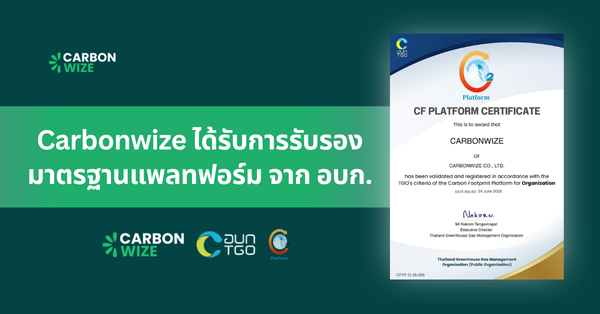
Carbonwize Becomes a TGO-Certified Carbon Platform
This marks a significant step in elevating Thailand's greenhouse gas management standards. Our platform has been audited by the Thailand Greenhouse Gas Management Organization (Public Organization), or TGO, an agency under the Ministry of Natural Resources and Environment that sets national standards for reporting greenhouse gas emissions and removals. Receiving the CFO Platform certification is clear evidence that Carbonwize can help organizations ensure the accuracy of their carbon calculations, in line with national standards, allowing all types of organizations to use the platform.

How will the new “Clean Air Act” change Thai lives and businesses?
Thailand is facing a major environmental turning point as the “Clean Air Act” was approved by the House of Representatives on October 21, 2025. This is a historic environmental law driven by public demand, with over 30 organizations, led by the Thailand Clean Air Network (THCAN), continuously advocating for more than 5 years. Summary of Latest Status * The draft law has “passed its third reading” in the House of Representatives on October 21, 2025. * It will then be sent to the Senate for consideration within 30 days. * The Clean Air Act is expected to